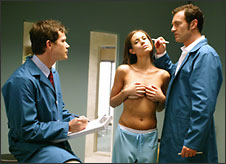
Paging
Dr. Welby
An article
written poignantly
about the new world of TV Medical Shows by Ingrid Katz and
Alexi Wright who are medical residents at Brigham and Women's Hospital
in Boston and clinical fellows in medicine at Harvard Medical School.
On the
season's first episode
of Grey's Anatomy, surgical intern Meredith Grey was drafted to help a
pediatric surgeon, who happens to be her boyfriend's wife, operate on a
pregnant woman, who happens to have lost her husband to an affair.
Genius.
As doctors, though, we haven't been dreading the show's reappearance
because
of its silly plot twists. We have a professional beef with Grey's
Anatomy:
Along with House, the other hospital show on the air at the moment, it
is medically far-fetched and misleading. Most of all, we dislike the
show
because it loses sight of the point of any medical enterprise—the
patients.
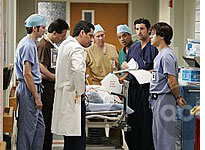
It hasn't
always been so.
The TV medical dramas of the 1960s brought viewers to patients'
bedsides
and kept them there. Shows like Ben Casey and Marcus Welby, M.D., were
structured around patients in part because doctors had a surprising
degree
of control over their TV image. However self-servingly, they nudged
producers
to paint a clearer, better picture of medicine than today's shows.
The
American Medical Association
started campaigning in the early 20th century to redefine doctors as
scientists
and healers, rather than quacks and leech-bearing butchers. When the
first
medical dramas hit the airwaves in 1951 with the debut of City
Hospital,
the AMA demanded from television producers the right to revise scripts
in the name of medical accuracy. The association struck deals with NBC
and ABC that gave it veto rights in exchange for an AMA seal of
approval
to be aired at the end of each vetted show. Often the AMA wasted its
time
carping about decorum. On Ben
Casey, male
doctors were
not allowed to be seen sitting on female patients' beds, driving fancy
cars, or discussing dying patients casually over coffee. Nor, usually,
were they allowed to make mistakes. AMA representatives were hawks for
medical accuracy, ensuring that surgeons held scalpels properly. They
were
also careful to protect their own interests, editing out story lines
that
focused on medical malpractice, according to Dr. Joseph Turow,
professor
at the University of Pennsylvania's Annenberg School of Communication
and
author of Playing Doctor: Television, Storytelling, and Medical Power.
The AMA
also pushed to keep
the focus away from physicians' personal lives. Throughout the '50s and
'60s, shows like Ben Casey; Dr. Kildare; and Marcus Welby, M.D. instead
spotlighted patient dilemmas that stood in for larger societal
problems.
On one episode in which Dr. Casey took care of a young girl beaten by
her
father, his show explored the ramifications of child abuse. In another,
Dr. Kildare became responsible for a mentally disabled man who was the
brother of a patient who had died. Patients' struggles drove the story
lines. They were the complex characters while the physicians were
typecast
as one-dimensional superheroes, always available, ever altruistic and
humble,
without any problems of their own.
The AMA's
reign began to
crumble in the mid-'60s with the rise of a new show, The Nurses. Its
producer,
Herbert Brodkin, refused to hire AMA vetters, instead employing a nurse
to ensure medical accuracy. The Nurses flopped. But it put an end to
the
AMA's hegemony. Then, in the 1970s, the new hit series M*A*S*H further
altered the formula by treating doctors with utter irreverence. Set on
the front lines of the Korean War, the show critiqued authority in
general
along with the U.S. military presence in Vietnam. Drs. "Hawkeye" Pierce
and "Trapper John" McIntyre (played by Alan Alda and Wayne Rogers) were
as dedicated to chasing nurses and drinking homemade hooch as they were
to performing surgeries.
Over the
next few decades,
medical dramas continued to write scripts around physicians.
Advertisers
ate up shows that encouraged young professionals
to watch
characters they
could identify with. St. Elsewhere and ER get credit for portraying
decaying
urban hospitals and taking on controversial story lines—St. Elsewhere
was
the first prime-time drama to feature an AIDS patient; ER was the first
to show a lesbian doctor. But the shows filtered every experience
through
the eyes of a doctor or nurse. Unlike their godlike predecessors, the
physicians
on these series were pathetically human, battling drug addictions,
health
problems, and bad relationships.
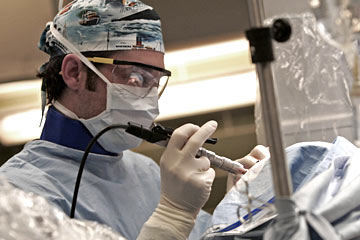
Grey's
Anatomy is an extreme
of this genre. In last season's premiere, blond and attractive Meredith
Grey oversleeps on the first day of her surgical residency after a
one-night
stand with a stranger—who later turns out to be her boss. As the show
unfolds
throughout the season, the two struggle to stay apart, soap-opera
style.
Meanwhile, Grey and her fellow interns suffer through the humiliations
of residency, from an abusive chief nicknamed "the Nazi" to a
hospital-wide
syphilis epidemic started by a surgical intern.
Many
moments would make the
old-time AMA vetters cringe. Instead of asexual father figures, the
doctors
on cast are hyper-hormonal. Attendings sleep with residents. Interns
bed
nurses. Even patients are fair game. On one episode, Grey kisses an
injured
biker brought in to the hospital after an accident involving spokes
sticking
out of his abdomen. Normally, any of these infractions would be grounds
for dismissal. At Grey's hospital, they're all in a day's work.
These
breaches, however,
are minor. What matters are the glaring inaccuracies in complicated and
delicate areas of medicine. In one egregious episode, the character
played
by Sandra Oh, Cristina Yang, asks a woman to donate her husband's
organs
after he dies unexpectedly. Yang botches the job, dispassionately
asking
for the husband's eyes and skin as if they were no more than items on a
grocery list. Then she runs out of the room as the wife begins to cry.
The scene
is rife with errors
that could damage public perception of organ donation, starting with
the
premise: Yang is angling for the husband's organs because another
patient
(who also happens to be a close friend of the chief of surgery) is
dying
from liver failure and will be saved if the wife agrees. In real life,
hospitals go to great lengths to prevent exactly these types of
conflicts
of interest, barring doctors from approaching patients directly and
designating
statewide organizations instead of individual hospitals to distribute
organs.
Maybe we're just two overeducated doctors who take television too
seriously,
but we worry that this plot line could have done real harm by
discouraging
people from donating.
|

Due to popular
demand, we've
brought back this section! Here's a few more factoids we found by Chuck
Shepard of "News of the Weird")
Vaginas-R-Us
In July,
envelope-pushing
strip club owner Howard White changed the main sign for his joint on
Century
Boulevard near Los Angeles International Airport from "Live Nude Nude
Nudes"
to "Vaginas R Us." Neighboring merchants immediately complained, but
city
officials said that "vagina" is simply not an obscene word. However,
the
city did cite White's sign for being made of illegal combustible vinyl.
At press time, opponents of the sign were trying to encourage the Toys
R Us company to force White to abandon the name as too similar to its
own
protected trademark. [Daily Breeze (Torrance, Calif.), 8-8-05]
Note
from the Editor:
And the topless joint next door promptly changed their name to "Areolae-R-Us"
-NL
Doctor on
the Rag
Dr. Thomas
Perls, director
of the New England Centenarian Study at Boston University Medical
School,
told a conference in Brisbane, Australia, in March that he donates
blood
regularly because one of the key reasons why females outlive males is
menstruation.
Perls said iron loss inhibits the growth of free radicals that age
cells.
"I menstruate," he said, "but only every eight weeks." [News Limited
(Australia),
3-19-05]
Note
from the Editor:
So those Medieval docs might have been on to something with that bloodletting?
Oh,
by the way, if
he's really menstruating, where does he put the tampon? -NL
Will the
real penis please...er...
stand up?
News of the
Weird has reported
several cases of sexual assault that turned on whether a victim's
identification
of a suspect could be sustained by a description of the assailant's
penis.
In May 2006, Sault Ste. Marie, Ontario, physician Anthony DeLuco
attempted
to defend himself at a disciplinary hearing by proving, via an
erection-inducing
injection, that his penis was not, as a patient had charged, "crooked."
The result was inconclusive, in that his erection curved upward,
although
not "crooked" to the left or right. (The Ontario College of Physicians
and Surgeons was, at press time, still deliberating his case.) [Globe
and
Mail, 5-10-05; Canadian Press, 7-12-05]
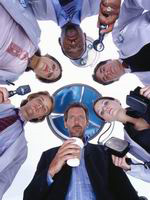 A brief
list of some Medical
TV Shows:
A brief
list of some Medical
TV Shows:
- ER
- Crossing
Jordan
- House
- M*A*S*H
- Casualty
- Rescue
Me
- Emergency!
- Nip/Tuck
- Chicago
Hope
- Diagnosis
Murder
- Holby
City
- official site from
the BBC.
- Third
Watch
- St.
Elsewhere
- Presidio
Med
- Doc
- Grey's
Anatomy
- Kingdom
Hospital
- Rescue
77
- Peak
Practice
- Dr.
Vegas
- All
Saints
- Strong
Medicine
- Medical
Investigation
- City
of
Angels
- MDA:
Medical Defence (Australia)
- chronicles the lives and cases of medical defence lawyers.
- Quincy
-
cast, crew, and background
information on the show starring Jack Klugman as a crime-fighting
coroner.
- Gideon's
Crossing
- MDs
- Flying
Doctors, The (Australia)
- Resources
for Medical Fanfiction
Writing - collection of
- helpful
links including emergency
medicine sites and general medical information sites.
- L. A.
Doctors
- Dr.
Quinn
- Medicine Woman
- Dr.
Welby,
M.D.
- Dr.
Kildare
- Ben
Casey
- General
Hospital
Do you know of
any others...
or maybe our "patients" from outside the U.S. can indulge us with the
names
of the Medical TV Shows on their Tellies?? If so, feel free to send us
the info: Nurse@MedicalToys.com
Paging...
continued
In another
episode, two of
the characters experiment on a patient, performing an illegal autopsy
against
a family's wishes. On the show, the characters are forgiven, instead of
arrested, because they discover the patient had a rare genetic disease
(which Oh blithely mispronounces). But as doctors, we could not forgive
the producers for their superficial all's-well ending. Since the
Tuskegee
tragedy, doctors have instilled institutional checks to ensure that
clinical
research is ethical. Still, many patients avoid doctors because they
are
afraid of being experimented on. The autopsy on Grey's Anatomy's
casually
corroborated their worst fears.
Watching
these episodes makes
us long, in spite of ourselves, for the days when the AMA had
television
producers on a tight leash. Don't get us wrong: We don't miss Dr.
Welby's
starched white coat. But we are afraid that TV's worst inaccuracies may
compromise what trust remains between doctors and patients.
A few
months ago, one of
our patients left the hospital emergency room before getting treated
because
he did not want to miss a Grey's Anatomy episode. As he signed out
against
his doctors' advice, he reminded us that medical shows are sometimes
better
than patient realities. Maybe so. But the patients are what real
doctoring
is all about.
|